The World's Most Chanted Ganapati

Where a single sacred sound, multiplied by millions of devoted voices, becomes a tide of blessing for the world.

In the Vedic tradition, a mantra is not merely words — it is sound given living form through devotion. Repeated with faith, it shapes the inner world of the one who chants. Repeated by millions, it shapes the world itself.

Why Chanting Is Powerful

Every recitation of the sacred name is an act of focused intention. The sound steadies the mind, opens the heart, and aligns the devotee with the divine. This is why the tradition speaks of repetition — not as routine, but as accumulation. Each chant adds to the last, building an unseen reservoir of spiritual energy.

When one person chants, they are transformed. When a family chants together, a home is blessed. When a community chants as one, obstacles dissolve. And when devotees across continents unite their voices toward a shared count, the blessing flows outward to all of humanity.

ॐ गं गणपतये नमः
Om Gam Ganapataye Namaha
The Three Sacred Foundations

Pṛthvī  +  Agni  +  Mantra

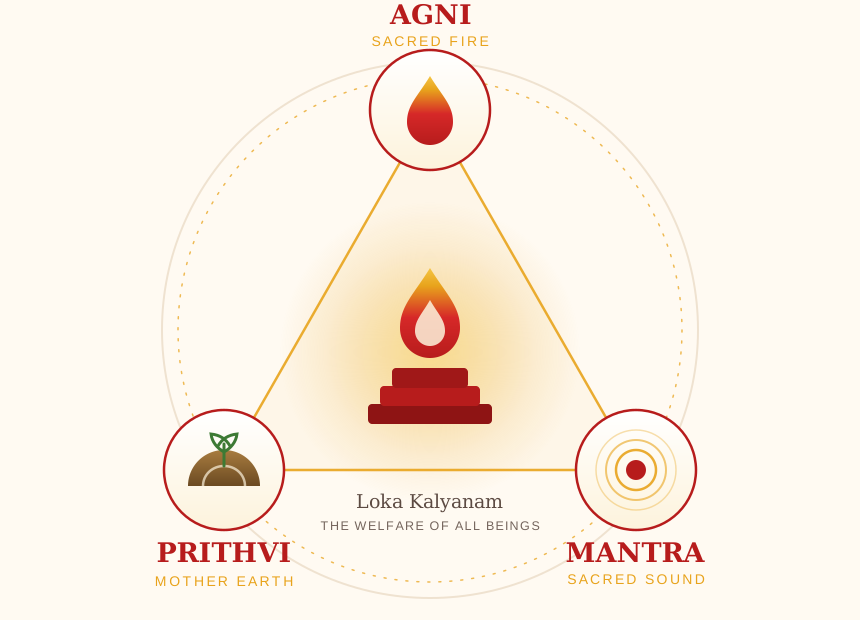
Earth  ·  Sacred Fire  ·  Mantra — the three foundations on which the KotiGanapati MahaYagnam rests.

A triangle diagram of the three sacred foundations — Prithvi (Mother Earth) at the lower left, Agni (Sacred Fire) at the apex and Mantra (Sacred Sound) at the lower right, with a yagna kunda burning at the centre
When Earth receives, Agni carries and Mantra gives sacred intention, the MahaYagnam becomes a prayer for Loka Kalyāṇam.
🌍

Pṛthvī — Earth

The Yagna Kunda should maintain a sacred connection with Mother Earth. The union of mantra, Agni and Earth is central to the MahaYagnam.

🔥

Agni — Sacred Fire

Agni should be kindled and sustained using suitable sacred wood, pure cow ghee and prescribed Yagna Samagri. Agni carries the mantra-charged offerings and prayers.

🕉️

Mantra — Sacred Vibration

Mantras should be recited with correct pronunciation, rhythm, devotion and Sankalpa by a properly trained Vedic practitioner who understands their meaning and discipline.

Pṛthvī — Mother Earth Receives

The Yagna Kunda is not a vessel placed upon the ground; it is joined to the ground. Every offering made into the fire is, in the end, an offering returned to the Earth that produced it — the ghee, the grain, the wood, the flowers. The Vedic seers were unambiguous about the relationship this implies.

Atharvaveda 12.1.12 — the Bhūmi Sūkta
माता भूमिः पुत्रोऽहं पृथिव्याः । पर्जन्यः पिता स उ नः पिपर्तु ॥
mātā bhūmiḥ putro 'haṃ pṛthivyāḥ | parjanyaḥ pitā sa u naḥ pipartu ||
“Earth is my mother, I am the son of Earth; Parjanya, the rain-cloud, is my father — may he nourish us.”
The Bhūmi Sūkta runs to sixty-three verses in praise of the Earth — one of the oldest sustained environmental hymns in any language. The relationship it names is not ownership but kinship. Source: Atharvaveda 12.1

Agni — The Sacred Fire Carries

Agni is kindled and sustained with suitable sacred wood, pure cow ghee and the prescribed Yagna Samagri. He is the one who carries: what is placed in the fire with a mantra does not simply burn, it travels. This is why the Vedas open with his name and not another's.

Ṛgveda 1.1.1 — the first verse of the Vedas
अ॒ग्निमी॑ळे पु॒रोहि॑तं य॒ज्ञस्य॑ दे॒वमृ॒त्विज॑म् । होता॑रं रत्न॒धात॑मम् ॥
agnim īḷe purohitaṃ yajñasya devam ṛtvijam | hotāraṃ ratnadhātamam ||
“I praise Agni — the one placed in front, the divine ministrant of the sacrifice, the invoker, the greatest bestower of treasure.”
Purohita means “placed in front” — Agni goes ahead of the worshipper as messenger and priest. Ratnadhātama, “best bestower of treasure”, was never read narrowly as wealth: it meant health, insight, progeny and peace. Source: Ṛgveda 1.1.1

Mantra — Sacred Vibration Gives Intention

Mantras are recited with correct pronunciation, rhythm, devotion and Sankalpa, by a properly trained Vedic practitioner who understands their meaning and discipline. Without that intention, an offering is only fuel; with it, the offering becomes a prayer. To understand why repetition at the scale of lakhs and crores is held to be so powerful, see The Power of Japa.

Ṛgveda 1.164.39 · also quoted at Śvetāśvatara Upaniṣad 4.8
ऋ॒चो अ॒क्षरे॑ पर॒मे व्यो॑म॒न्यस्मि॑न्दे॒वा अधि॒ विश्वे॑ निषे॒दुः ।
यस्तन्न वेद॒ किमृ॒चा क॑रिष्यति॒ य इत्तद्वि॒दुस्त इ॒मे समा॑सते ॥
ṛco akṣare parame vyoman yasmin devā adhi viśve niṣeduḥ |
yas tan na veda kim ṛcā kariṣyati ya it tad vidus ta ime samāsate ||
“In the imperishable syllable of the ṛc, in the highest heaven, wherein all the gods are seated — he who does not know That, what will he do with the ṛc? But they who know it, they sit here assembled.”
A remarkably direct warning from the Ṛgveda itself: recitation without understanding accomplishes little. Meaning, discipline and devotion are not additions to the mantra — they are the mantra. Source: Ṛgveda 1.164.39
Discipline of the Practitioner

Sāttvika Discipline and the True Meaning of Brāhmaṇa

Sāttvika Discipline. Those leading the mantras maintain purity in thought, speech, conduct and diet. A pure vegetarian diet without meat, eggs, onions or garlic is traditionally preferred. Those who voluntarily follow an even stricter plant-based discipline may do so as part of their personal sādhana.

The True Meaning of Brāhmaṇa. A Brāhmaṇa is not defined merely by birth or title, but by Vedic knowledge, self-discipline, truthfulness, compassion, purity and dedicated spiritual practice. This is not a modern reinterpretation — it is the answer Yudhiṣṭhira gives when the question is put to him directly in the Mahābhārata.

Mahābhārata 3.177.16 — Vana Parva, Ajagara Parva
सत्यं दानं क्षमा शीलमानृशंस्यं दमो घृणा ।
दृश्यन्ते यत्र नागेन्द्र स ब्राह्मण इति स्मृतः ॥
satyaṃ dānaṃ kṣamā śīlam ānṛśaṃsyaṃ damo ghṛṇā |
dṛśyante yatra nāgendra sa brāhmaṇa iti smṛtaḥ ||
“Truth, charity, forbearance, good conduct, freedom from cruelty, self-restraint and compassion — in whom these are seen, O lord of serpents, he is remembered as a Brāhmaṇa.”
The serpent asks Yudhiṣṭhira plainly: brāhmaṇaḥ ko bhaved rājan — “who, O king, is a Brāhmaṇa?” The answer names seven qualities and not one of them is birth. A few verses later the same passage adds: “where this conduct is seen, he is held a Brāhmaṇa; where it is absent, he is not.” Source: Mahābhārata, Vana Parva (Ganguli tr., Section CLXXX)

When Earth receives the offerings, Agni carries them and Mantra gives them sacred intention, the KotiGanapati MahaYagnam becomes a powerful prayer for Loka Kalyāṇam — the welfare of all beings.

Śukla Yajurveda 36.17 — the Śānti Mantra
द्यौः शान्तिरन्तरिक्षं शान्तिः पृथिवी शान्तिरापः शान्तिरोषधयः शान्तिः ।
वनस्पतयः शान्तिर्विश्वेदेवाः शान्तिर्ब्रह्म शान्तिः सर्वं शान्तिः शान्तिरेव शान्तिः सा मा शान्तिरेधि ॥
dyauḥ śāntir antarikṣaṃ śāntiḥ pṛthivī śāntir āpaḥ śāntir oṣadhayaḥ śāntiḥ |
vanaspatayaḥ śāntir viśvedevāḥ śāntir brahma śāntiḥ sarvaṃ śāntiḥ śāntir eva śāntiḥ sā mā śāntir edhi ||
“May the heavens be peace, the atmosphere peace, the earth peace, the waters peace, the herbs peace, the forest trees peace, the All-Gods peace, Brahman peace, the All peace, peace itself peace — may that peace come to me.”
Peace is invoked for the sky, the air, the earth, the water and the plants before it is asked for oneself. Loka Kalyāṇam is not a sentiment appended to the yagna; it is the order in which the yagna prays. Source: Śukla Yajurveda 36.17
The Sacred Mathematics of Devotion

From One Crore to One Hundred Crore

The mission ascends through sacred thresholds — each one multiplying the blessing many times over.

1 Cr10 Million

The First Ocean of Sound

One crore — ten million — recitations form the foundation of the MahaYagnam. At this threshold, individual prayer becomes collective power, strong enough to remove obstacles from countless lives. This is the first great goal: to gather one crore prayers from one crore devotees.

10 Cr100 Million

A Tide Across Nations

Ten crore — one hundred million — recitations carry the vibration far beyond any single community. The chanting becomes a shared inheritance, its grace flowing across cities, countries, and continents. What began as a gathering becomes a movement; what began as a movement becomes a tide.

100 Cr1 Billion

A Blessing for All Generations

One hundred crore — one billion — recitations stand as an offering for the whole of humanity. A reservoir of grace of this magnitude is not for one age alone; it is intended to radiate peace, unity, and protection for generations yet unborn. This is the highest aspiration of the mission.

The 9-Day MahaYagnam

The divine journey will culminate in a nine-day MahaYagnam at the Hyderabad Temple. This sacred fire ritual will be performed by 1008 devotees offering prayers together for global peace, family unity, and spiritual upliftment. In the fire offering, the mantra is sealed with Swaha: ॐ गं गणपतये स्वाहा (Om Gam Ganapataye Swaha).

The number is itself a prayer: 1008 is among the most auspicious in the tradition, representing wholeness and the infinite. When 1008 devotees offer the fire ritual as one, the union of Vedic wisdom and sacred family energy invokes blessings meant to endure across the ages.

How Devotees Participate

Participation is open to all. Devotees join the Sahasra Parayana MahaYagna gatherings as they travel city to city, adding their recitations to the growing count. Families chant together at home. Couples and single devotees alike step forward to take part in the sacred rituals. Every voice counts — quite literally — toward the one crore and beyond.

Manusmriti 2.87
जप्येनैव तु संसिध्येद् ब्राह्मणो नात्र संशयः ।
japyenaiva tu saṁsidhyed brāhmaṇo nātra saṁśayaḥ
“By japa alone one surely attains perfection — of this there is no doubt.”
The tradition holds japa — sustained, repeated chanting — as a complete spiritual path in itself, sufficient to carry the devotee to the highest goal. To explore why repetition at the scale of lakhs and crores is considered so powerful, and how group chanting multiplies the effect, visit The Power of Japa. Source: Manusmriti 2.87

Add Your Voice to the Count

Join the Sahasra Parayana MahaYagna and become part of the world's most chanted Ganapati.

See the World Tour →